

US high court rules against soybean farmer in seed-patent case

The US Supreme Court has issued a unanimous ruling today that a soybean farmer violated patents when he planted genetically modified soybeans without first paying the intellectual-property holder. The case pitted Hugh Bowman, a septuagenarian soybean grower from Indiana, against Monsanto, the agricultural technology giant based in St Louis, Missouri. Bowman was a loyal customer of Monsanto’s genetically modified, herbicide-resistant soybeans, until he decided one year to buy seeds from a grain elevator. The elevator was known to contain seeds from Monsanto’s weed-killer-resistant plants, and Bowman selected for those soybeans by spraying his fields with herbicide. He then saved seeds from surviving soybeans to plant the next season. After eight seasons of this, Monsanto sued for violation of its patent rights: the company requires customers to buy seeds each season. Bowman argued that Monsanto’s patents had been ‘exhausted’ after the initial sale of its seed to farmers, leaving the company no hold over the seed he purchased from the grain elevator. Monsanto, in turn, argued that each year Bowman saved seed and replanted it, he had replicated the company’s patented technology. All nine Supreme Court justices agreed with the company: “Bowman planted Monsanto’s patented soybeans solely to make and market replicas of them, thus depriving the company of the reward patent law provides for the sale of each article,” wrote Justice Elena Kagan for the court. “Patent exhaustion provides no haven for that conduct.” The decision comes as a relief to the biotechnology industry, which saw the case as a potential threat not only to agricultural biotechnology, but also to any ‘self-replicating’ technology such as genetically modified bacteria or viruses. Still, that doesn’t mean such technologies will always be as well protected as Monsanto’s soybeans, cautioned Kagan. “Our holding today is limited — addressing the situation before us, rather than every one involving a self-replicating product,” she wrote. “We recognize that such inventions are becoming ever more prevalent, complex, and diverse. In another case, the article’s self-replication might occur outside the purchaser’s control.”


Refurbished Alvin submersible returns to sea
 After a two-year, US$41-million upgrade, the venerable Alvin submersible is about to return to sea.
On 25 May, the research ship Atlantis will leave the Woods Hole Oceanographic Institution (WHOI) in Massachusetts with Alvin on board, bound for Astoria, Oregon. After a series of US Navy certification cruises in September and a scientific-verification cruise in November, Alvin will return to full service in December studying the deep ocean off the US Pacific Northwest.
The main improvement in this first phase of the Alvin upgrade is the new titanium sphere where the sub’s three-person crew sits (see Nature’s feature story ‘Deep-sea research: Dive master‘). It is 18% bigger than the previous sphere and has two extra windows and high-definition cameras, giving the scientists a better view of the deep ocean. It also has more comfortable seats. In addition, the manipulator arms have longer reach, and the sample-collection basket can carry twice as much weight — up to 181 kilograms.
Even though the new sphere was designed to travel to depths of 6,500 metres, Alvin will still be limited to its old depth of 4,500 metres after the first phase of the upgrade. Holding it back from greater depths are battery limitations, says Susan Humphries, who is in charge of the upgrade programme at WHOI. Alvin uses lead–acid batteries, which do not provide enough power for longer, deeper dives. Lithium-ion batteries would be better, but are considered to have too great a risk of fire for now. “In a few years, once the battery technology has matured, we’ll complete phase two,” says Humphries. She hopes that within five years, when Alvin is scheduled for regular maintenance, the problem will be solved.
In the meantime, ocean scientists are eager to get back below the waves. Over its five-decade career, Alvin has been responsible for revealing some of the deep ocean’s biggest surprises, including the famous ecosystems powered by hydrothermal vents rather than sunlight. Julie Huber, a microbiologist at the Marine Biological Laboratory, also in Woods Hole, has been on three Alvin dives in the past. She is looking forward to the new exploration opportunities, but sounds a note of caution: “I want to wait for them to have 50 safe dives under their belt before I go back.”
After a two-year, US$41-million upgrade, the venerable Alvin submersible is about to return to sea.
On 25 May, the research ship Atlantis will leave the Woods Hole Oceanographic Institution (WHOI) in Massachusetts with Alvin on board, bound for Astoria, Oregon. After a series of US Navy certification cruises in September and a scientific-verification cruise in November, Alvin will return to full service in December studying the deep ocean off the US Pacific Northwest.
The main improvement in this first phase of the Alvin upgrade is the new titanium sphere where the sub’s three-person crew sits (see Nature’s feature story ‘Deep-sea research: Dive master‘). It is 18% bigger than the previous sphere and has two extra windows and high-definition cameras, giving the scientists a better view of the deep ocean. It also has more comfortable seats. In addition, the manipulator arms have longer reach, and the sample-collection basket can carry twice as much weight — up to 181 kilograms.
Even though the new sphere was designed to travel to depths of 6,500 metres, Alvin will still be limited to its old depth of 4,500 metres after the first phase of the upgrade. Holding it back from greater depths are battery limitations, says Susan Humphries, who is in charge of the upgrade programme at WHOI. Alvin uses lead–acid batteries, which do not provide enough power for longer, deeper dives. Lithium-ion batteries would be better, but are considered to have too great a risk of fire for now. “In a few years, once the battery technology has matured, we’ll complete phase two,” says Humphries. She hopes that within five years, when Alvin is scheduled for regular maintenance, the problem will be solved.
In the meantime, ocean scientists are eager to get back below the waves. Over its five-decade career, Alvin has been responsible for revealing some of the deep ocean’s biggest surprises, including the famous ecosystems powered by hydrothermal vents rather than sunlight. Julie Huber, a microbiologist at the Marine Biological Laboratory, also in Woods Hole, has been on three Alvin dives in the past. She is looking forward to the new exploration opportunities, but sounds a note of caution: “I want to wait for them to have 50 safe dives under their belt before I go back.”
Quake off eastern Russia may be biggest-ever deep temblor
 An extraordinarily deep earthquake shook Russia’s Far East this morning. The magnitude-8.3 quake took place nearly 610 kilometres below Earth’s surface, according to preliminary estimates from the US Geological Survey.
Normally rocks at this depth are too hot to rupture quickly in a quake; instead, they deform slowly, like hot wax flowing rather than cold wax shattering. But beneath the Sea of Okhotsk, north of Japan and west of Russia’s Kamchatka Peninsula, the sea floor — a slab of old Pacific crust — is diving beneath Eurasia. The crust is descending fast enough — about 8 centimetres per year — to remain cool enough to rupture even at great depths. The diving plate is thus seismically active down to 650 kilometres or greater.
The epicentre of today’s quake was about 400 kilometres northwest of the
seismic
city of Petropavlovsk-Kamchatsky. Deep quakes cause less damage than shallow ones, and early news reports suggest that injury and damage were minimal, although the shaking was felt as far away as Moscow. (Pictured, at right, is the seismic signal as recorded in Ruedersdorf, Germany.) A tsunami warning was issued and lifted soon thereafter.
A series of smaller quakes, up to about magnitude 6.0, had shaken just south and east of Petropavlosk-Kamchatsky over the past several days. But they were far shallower. Figuring out how the shallow earthquake swarm and the large deep quake are related — if they are — is likely to be a topic of intense study.
An extraordinarily deep earthquake shook Russia’s Far East this morning. The magnitude-8.3 quake took place nearly 610 kilometres below Earth’s surface, according to preliminary estimates from the US Geological Survey.
Normally rocks at this depth are too hot to rupture quickly in a quake; instead, they deform slowly, like hot wax flowing rather than cold wax shattering. But beneath the Sea of Okhotsk, north of Japan and west of Russia’s Kamchatka Peninsula, the sea floor — a slab of old Pacific crust — is diving beneath Eurasia. The crust is descending fast enough — about 8 centimetres per year — to remain cool enough to rupture even at great depths. The diving plate is thus seismically active down to 650 kilometres or greater.
The epicentre of today’s quake was about 400 kilometres northwest of the
seismic
city of Petropavlovsk-Kamchatsky. Deep quakes cause less damage than shallow ones, and early news reports suggest that injury and damage were minimal, although the shaking was felt as far away as Moscow. (Pictured, at right, is the seismic signal as recorded in Ruedersdorf, Germany.) A tsunami warning was issued and lifted soon thereafter.
A series of smaller quakes, up to about magnitude 6.0, had shaken just south and east of Petropavlosk-Kamchatsky over the past several days. But they were far shallower. Figuring out how the shallow earthquake swarm and the large deep quake are related — if they are — is likely to be a topic of intense study.


Burim "B1" Jusufi at Rihanna - Last Girl On Earth Tour
Burim "B1" Jusufi at Rihanna - Last Girl On Earth Tour


Be Cool, Elmore Leonard: Paying Homage to a Man Who Proved Hard Work Pays Off, Part II

A funeral was held earlier today for Elmore Leonard, the acclaimed Detroit, Michigan-area crime novelist who died this last Tuesday at age 87. Detroit Free Press staff reporter Jim Schaefer explains that Leonard’s Mass included “tears and laughter, and military honors for his time in the Navy during World War II.” He adds: About 325 people gathered inside Holy Name Catholic Church in Birmingham on Saturday morning to say good-bye. The listeners included longtime friend Mike Lupica, a sportswriter and novelist, and Timothy Olyphant, an actor in the FX TV series “Justified,” which is based on Leonard’s works. “Elmore truly was gifted with creativity, skill and talent,” the Rev. Joe Grimaldi said during his homily. “The twinkle in his eye showed he also enjoyed having fun.” Fun was certainly had as well by Leonard’s millions of devoted readers. In Part II of The Rap Sheet’s tribute to this late author, posted below, we offer more than two dozen recollections of his work, as well as thoughts on his legacy, contributed by novelists and critics both. Part I of our feature can be enjoyed here. Again, Rap Sheet readers may add their own thoughts on Leonard’s life and work in the Comments section at the end of this post.
Turkey's Prime Minister Erdogan, the Turkish flag lifted from the ground! 'G20 Russia'
Turkey's Prime Minister Erdogan, the Turkish flag lifted from the ground! 'G20 Russia'


World News - Snake attacks kill at least 60 in Iraq
 Latest World News 24h Plz Subscrib for Latest World News Snake attacks kill at least 60 in Iraq.

NSA Creating Spy System To Monitor Domestic Infrastructure
 The National Security Agency has begun work on an "expansive" spy system that will monitor critical infrastructure inside the United States for cyber-attacks, in a move that detractors say could end up violating privacy rights and expanding the NSA's domestic spying abilities.
The Wall Street Journal cites unnamed sources as saying that the NSA has issued a $100-million contract to defense contractor Raytheon to build a system dubbed "Perfect Citizen," which will involve placing "sensors" at critical points in the computer networks of private and public organizations that run infrastructure, organizations such as nuclear power plants and electric grid operators.
The National Security Agency has begun work on an "expansive" spy system that will monitor critical infrastructure inside the United States for cyber-attacks, in a move that detractors say could end up violating privacy rights and expanding the NSA's domestic spying abilities.
The Wall Street Journal cites unnamed sources as saying that the NSA has issued a $100-million contract to defense contractor Raytheon to build a system dubbed "Perfect Citizen," which will involve placing "sensors" at critical points in the computer networks of private and public organizations that run infrastructure, organizations such as nuclear power plants and electric grid operators.
The Foundations Have Been Laid Long Ago
 (The Apotheosis of George Washington as displayed on the ceiling of the Rotunda of the Capitol Building in Washington, DC (painted by Constantino Brumidi - 1865). It depicts George Washington rising to the heavens in glory sitting on a throne as a God. Very few recognize the spiritual elements of the architecture and the symbolism of this building which literally makes it a temple of Masonic mysteries. The city of Washington is even located in the District of the (Goddess of Columbia). In 1791, President Washington commissioned Pierre (Peter) Charles L’Enfant, a French-born architect, city planner and freemason, to design the new capital and City of Washington. The masons had wanted America to be a 'New Atlantis' and Washington, D.C. a second Rome. They were committing America to what has been called 'A Secret Destiny'. This future 'destiny', is 'The New World Order'. Watch a youtube video on The New World Order; Listen to an audiobook on Freemasonry - The Truth (right click to download))
In order for a global "New World Order" economic system to be established with a one-world electronic currency the sovereignty of all nations must be undermined. Then, and only then, will everyone be forced to exist and live within the confines of a single global police state thereby losing our freedoms and rights as free human beings.
The ideal of a "New World Order" might never be closer than now. It may not be long before all of us experience an abrupt change in our way of living. There has been a group that consists of Masons, Jewish Bankers, and other influential wealthy individuals that has worked for a very long time through Freemasonry and the Order of the Illuminati to achieve this "New World Order". Their goal is to set up a Global Police State with a more controlled society and continuous surveillance over every citizen! First they’ll destroy this present world system (Old Order) and then bring in their global government. They have everything in place and ready to go so when the time is right they will make their move without any hesitation.
(The Apotheosis of George Washington as displayed on the ceiling of the Rotunda of the Capitol Building in Washington, DC (painted by Constantino Brumidi - 1865). It depicts George Washington rising to the heavens in glory sitting on a throne as a God. Very few recognize the spiritual elements of the architecture and the symbolism of this building which literally makes it a temple of Masonic mysteries. The city of Washington is even located in the District of the (Goddess of Columbia). In 1791, President Washington commissioned Pierre (Peter) Charles L’Enfant, a French-born architect, city planner and freemason, to design the new capital and City of Washington. The masons had wanted America to be a 'New Atlantis' and Washington, D.C. a second Rome. They were committing America to what has been called 'A Secret Destiny'. This future 'destiny', is 'The New World Order'. Watch a youtube video on The New World Order; Listen to an audiobook on Freemasonry - The Truth (right click to download))
In order for a global "New World Order" economic system to be established with a one-world electronic currency the sovereignty of all nations must be undermined. Then, and only then, will everyone be forced to exist and live within the confines of a single global police state thereby losing our freedoms and rights as free human beings.
The ideal of a "New World Order" might never be closer than now. It may not be long before all of us experience an abrupt change in our way of living. There has been a group that consists of Masons, Jewish Bankers, and other influential wealthy individuals that has worked for a very long time through Freemasonry and the Order of the Illuminati to achieve this "New World Order". Their goal is to set up a Global Police State with a more controlled society and continuous surveillance over every citizen! First they’ll destroy this present world system (Old Order) and then bring in their global government. They have everything in place and ready to go so when the time is right they will make their move without any hesitation.

Michael Parenti vs God & His Demons
 In a telephone interview with me on April 6, 2010, Left-leaning political scientist Michael Parenti discusses his book, God and His Demons (Prometheus Books)--a survey of the woes caused in the name of, and by, Organized Religion.
In Part One, Parenti talks about rampant child sexual abuse by the Christian (and other) clergy and the coverup thereof--and now, at the Vatican, the coverup of the coverup. He talks about the venality of the Protestant televangelists and the oppressive Buddhist theocracy in Tibet before the Chinese Communists took over. He talks about our society's ignoring some sins frequently denounced in the Bible--e.g., charging high interest rates ("usury")--while we piously condemn "sins" the Bible never mentions (gay marriage, abortion). And he rebuts creationism, "Intelligent Design," . . . and some of the conclusions of Charles Darwin.
In Part Two, Parenti discusses the unholy alliance of the Church, the nation-state, and economic power; ... FEMA's enlistment of the clergy to preach obedience to authority; ... and the Christian Right's takeover of the Air Force Academy. He ends with praise for 2 unorthodox 16th-century Christians--Montaigne and Giordano Bruno--and explaining why, despite everything, he's not an atheist.
In a telephone interview with me on April 6, 2010, Left-leaning political scientist Michael Parenti discusses his book, God and His Demons (Prometheus Books)--a survey of the woes caused in the name of, and by, Organized Religion.
In Part One, Parenti talks about rampant child sexual abuse by the Christian (and other) clergy and the coverup thereof--and now, at the Vatican, the coverup of the coverup. He talks about the venality of the Protestant televangelists and the oppressive Buddhist theocracy in Tibet before the Chinese Communists took over. He talks about our society's ignoring some sins frequently denounced in the Bible--e.g., charging high interest rates ("usury")--while we piously condemn "sins" the Bible never mentions (gay marriage, abortion). And he rebuts creationism, "Intelligent Design," . . . and some of the conclusions of Charles Darwin.
In Part Two, Parenti discusses the unholy alliance of the Church, the nation-state, and economic power; ... FEMA's enlistment of the clergy to preach obedience to authority; ... and the Christian Right's takeover of the Air Force Academy. He ends with praise for 2 unorthodox 16th-century Christians--Montaigne and Giordano Bruno--and explaining why, despite everything, he's not an atheist.

“Some Days we’re up. Some days we’re down.”
 “Everything that is wrong-headed, cynical, and vicious in me today traces back to that evil hour...when I decided to get heavily involved in the political process...”
- Hunter S. Thompson, Fear and Loathing on the Campaign Trail ’72
This past week will be remembered as the one Mitt Romney unofficially lost the 2012 Presidential election. Of course the Republican's polls have been nosedive the moment this whole sordid ship took-off into the stratosphere in the primaries. Yet again, the Republicans have only been successful at spending enormous amounts of campaign funds while totally unsuccessful at communicating any clear and/or reasonable argument for why Americans should vote the incumbent out. They have only managed to communicate a message of divisiveness and isolationism, good show.
One of the few things Republicans have been great at is providing the daily news cycle with an array of ignorant, offensive gaffes for the late night comedians to salivate and laugh over. For this, we’ll miss them. Of course, in politics, nothing is absolute, there’s still a little over 40 days until November 6th. Accordingly, it would be arrogant and unwise to assert the election is in the bag for Obama.
But it is hard not to celebrate; especially when the weekly polls -even in the most unpredictable of swing states- have been showing President Obama with a comfortable 10 point lead for weeks. On the New York Times Five Thirty Eight Blog, the President has a 77% chance of winning re-election. Ouch! This weekend, Mitt Romney will appear on 60 Minutes to tell the viewing audience that his campaign “Doesn’t need a turn-around.” Romney will admit that not everything he says is “elegant,” but that he “wants to make very clear [he's here] to help 100 percent of the American people.”
Yes, Romney continues to believe. (Even when many of his Republican colleagues don't.) As I’ve said throughout this campaign, the choice to “Believe in America” as the Romney campaign slogan suggests, is most apt; after all, to believe in anything means to also willingly ignore whatever happens in reality to disprove and/or challenge one’s ideology. Speaking on the Daily Show former President Bill Clinton said something great: “The problem with ideology is that it has the answer before it has any evidence.” Indeed. And yes, the reality is, Romney’s ideology has no evidence, only belief. Accordingly, he does not speak for, represent, nor, arguably, even care about the American people.
The stilted speeches and soaring rhetoric from the heavily fortified conventions in Tampa and then Charlotte, are now so very far away. Yet, it was only a few weeks ago that Romney and Obama accepted their nominations. At the RNC, Romney’s speech was interrupted twice by protestors. Of course, it has been a tough election from the start for the presumptive candidate. Even back in the Iowa straw poll, Romney was heckled by a man in the crowd about his remark, “Corporations are people my friend.” The only time Romney has appeared comfortable in front of an audience is in the now famous leaked tape of Romney speaking at a closed-door fundraiser, which (as we now all well know) was a speech full of damning, politically suicidal, sound bites.
Comments like this show Mitt Romney and President Barack Obama share completely different idealogical visions for our nation (something Mitt Romney himself has been correct in admitting). This election is between two dramatically alternative outcomes. Sure, both men have entered the same vicious and vile political game; nevertheless, the way they play it is in total contrast. As sports writer Grantland Rice once wrote, “When the Great Scorer comes to write against your name -he marks- not that you won or lost -but how you played the game.” How Romney and Obama play the game is totally different.
What would a Romney administration look like? Romney would likely do everything in his power (including choosing more Supreme Court justices) to prevent women from their right to choose (something he, of course, used to say he’d protect; however, now finds politically convenient to oppose...). Romney would seek to outsource American jobs to the lowest bidders (as he has in places like “Bain-port” . Companies that have been grasped up and consumed by private equity firms like Bain Capital. Which is -as Matt Taibbi succinctly argues here- the economic model a Romney administration would promote.
Taibbi writes, “Making money justifies any behavior, no matter how venal. The [new] owners of American industry are polar opposites of the Milton Hersheys and Andrew Carnegies who built this country.”) Romney’s foreign policy seems to be informed by the most ardent neoconservative hacks (see Romney’s treasonous response to the attack on the U.S. embassy in Benghazi). On immigration, Romney would make it so difficult for undocumented immigrants in the U.S. that they would “self-deport” themselves (compare this with Obama’s “dreamers” and support for passing the “dream act”). Gay marriage? Forget about it. Romney's vision for America is contradictory to liberty and the pursuit of happiness.
Pundits on all sides have been suggesting that Mitt's problem is that he has never been able to relate to "average" American voters. He’s awkward and mechanical. Romney’s forced staccato laughter further plays to the depiction of him as a disingenuous, elite, plutocrat. At times, I’ve tried to imagine what it would be like to sit and have a conversation with Mitt? After all, I never liked President Bush’s policies and decisions; but, nevertheless, I did feel like he would be the type of guy you would want to invite to a barbecue or sit beside at a baseball game. Bush had that folksy charm that is completely absent from the Romney campaign. Romney is not charismatic. The only thing Romney has going for him is an enormous amount of wealth and a large family.
Romney will lose. But no one should feel bad when he does; after all, Mitt will still be unconscionably wealthy and totally comfortable in any of his luxurious homes. But make no mistake, he will never be President of these United States. And with any hope, there will be some moment when Romney (and Super PACers, Karl Rove and Sheldon Adelson) will need to face the cold hard truth - you're not entitled to the office of the President. Money cannot buy votes.
Politics is a stupid and tawdry game, but it is also, as Hunter S. Thompson once said, “The art of controlling your environment.” A vibrant democracy is based on discussion, debate, and decisions. American voters have a choice this November and despite how cynical and critical we can get, it is important to remember that despite the limitations of our current political system, freedom is a struggle that never ends.
“If you turn away now - if you buy into the cynicism that the change we fought for isn’t possible - well, then change won’t happen.” - President Obama
“Everything that is wrong-headed, cynical, and vicious in me today traces back to that evil hour...when I decided to get heavily involved in the political process...”
- Hunter S. Thompson, Fear and Loathing on the Campaign Trail ’72
This past week will be remembered as the one Mitt Romney unofficially lost the 2012 Presidential election. Of course the Republican's polls have been nosedive the moment this whole sordid ship took-off into the stratosphere in the primaries. Yet again, the Republicans have only been successful at spending enormous amounts of campaign funds while totally unsuccessful at communicating any clear and/or reasonable argument for why Americans should vote the incumbent out. They have only managed to communicate a message of divisiveness and isolationism, good show.
One of the few things Republicans have been great at is providing the daily news cycle with an array of ignorant, offensive gaffes for the late night comedians to salivate and laugh over. For this, we’ll miss them. Of course, in politics, nothing is absolute, there’s still a little over 40 days until November 6th. Accordingly, it would be arrogant and unwise to assert the election is in the bag for Obama.
But it is hard not to celebrate; especially when the weekly polls -even in the most unpredictable of swing states- have been showing President Obama with a comfortable 10 point lead for weeks. On the New York Times Five Thirty Eight Blog, the President has a 77% chance of winning re-election. Ouch! This weekend, Mitt Romney will appear on 60 Minutes to tell the viewing audience that his campaign “Doesn’t need a turn-around.” Romney will admit that not everything he says is “elegant,” but that he “wants to make very clear [he's here] to help 100 percent of the American people.”
Yes, Romney continues to believe. (Even when many of his Republican colleagues don't.) As I’ve said throughout this campaign, the choice to “Believe in America” as the Romney campaign slogan suggests, is most apt; after all, to believe in anything means to also willingly ignore whatever happens in reality to disprove and/or challenge one’s ideology. Speaking on the Daily Show former President Bill Clinton said something great: “The problem with ideology is that it has the answer before it has any evidence.” Indeed. And yes, the reality is, Romney’s ideology has no evidence, only belief. Accordingly, he does not speak for, represent, nor, arguably, even care about the American people.
The stilted speeches and soaring rhetoric from the heavily fortified conventions in Tampa and then Charlotte, are now so very far away. Yet, it was only a few weeks ago that Romney and Obama accepted their nominations. At the RNC, Romney’s speech was interrupted twice by protestors. Of course, it has been a tough election from the start for the presumptive candidate. Even back in the Iowa straw poll, Romney was heckled by a man in the crowd about his remark, “Corporations are people my friend.” The only time Romney has appeared comfortable in front of an audience is in the now famous leaked tape of Romney speaking at a closed-door fundraiser, which (as we now all well know) was a speech full of damning, politically suicidal, sound bites.
Comments like this show Mitt Romney and President Barack Obama share completely different idealogical visions for our nation (something Mitt Romney himself has been correct in admitting). This election is between two dramatically alternative outcomes. Sure, both men have entered the same vicious and vile political game; nevertheless, the way they play it is in total contrast. As sports writer Grantland Rice once wrote, “When the Great Scorer comes to write against your name -he marks- not that you won or lost -but how you played the game.” How Romney and Obama play the game is totally different.
What would a Romney administration look like? Romney would likely do everything in his power (including choosing more Supreme Court justices) to prevent women from their right to choose (something he, of course, used to say he’d protect; however, now finds politically convenient to oppose...). Romney would seek to outsource American jobs to the lowest bidders (as he has in places like “Bain-port” . Companies that have been grasped up and consumed by private equity firms like Bain Capital. Which is -as Matt Taibbi succinctly argues here- the economic model a Romney administration would promote.
Taibbi writes, “Making money justifies any behavior, no matter how venal. The [new] owners of American industry are polar opposites of the Milton Hersheys and Andrew Carnegies who built this country.”) Romney’s foreign policy seems to be informed by the most ardent neoconservative hacks (see Romney’s treasonous response to the attack on the U.S. embassy in Benghazi). On immigration, Romney would make it so difficult for undocumented immigrants in the U.S. that they would “self-deport” themselves (compare this with Obama’s “dreamers” and support for passing the “dream act”). Gay marriage? Forget about it. Romney's vision for America is contradictory to liberty and the pursuit of happiness.
Pundits on all sides have been suggesting that Mitt's problem is that he has never been able to relate to "average" American voters. He’s awkward and mechanical. Romney’s forced staccato laughter further plays to the depiction of him as a disingenuous, elite, plutocrat. At times, I’ve tried to imagine what it would be like to sit and have a conversation with Mitt? After all, I never liked President Bush’s policies and decisions; but, nevertheless, I did feel like he would be the type of guy you would want to invite to a barbecue or sit beside at a baseball game. Bush had that folksy charm that is completely absent from the Romney campaign. Romney is not charismatic. The only thing Romney has going for him is an enormous amount of wealth and a large family.
Romney will lose. But no one should feel bad when he does; after all, Mitt will still be unconscionably wealthy and totally comfortable in any of his luxurious homes. But make no mistake, he will never be President of these United States. And with any hope, there will be some moment when Romney (and Super PACers, Karl Rove and Sheldon Adelson) will need to face the cold hard truth - you're not entitled to the office of the President. Money cannot buy votes.
Politics is a stupid and tawdry game, but it is also, as Hunter S. Thompson once said, “The art of controlling your environment.” A vibrant democracy is based on discussion, debate, and decisions. American voters have a choice this November and despite how cynical and critical we can get, it is important to remember that despite the limitations of our current political system, freedom is a struggle that never ends.
“If you turn away now - if you buy into the cynicism that the change we fought for isn’t possible - well, then change won’t happen.” - President Obama


US regulator plans to declare research chimps endangered

The US Fish and Wildlife Service (FWS) is planning to categorize all US chimpanzees as an endangered species, a change which, if enacted, may spell the end of invasive chimpanzee research. This soon-to-be-published proposed FWS rule, which will be open for 60 days of public comment before being finalized, would bring captive chimps — whether in zoos, private homes or research labs — under the protection of the Endangered Species Act, as wild chimps already are. If the FWS decides to list the captive animals as endangered, then using them for invasive research would require a special permit. To win one, researchers would have to show that any proposed study would promote the conservation of the species. Jane Goodall, the famous primatologist, called the move “an important step toward saving our closest living relatives from extinction”. She spoke on behalf of a coalition of animal welfare groups, including the Humane Society of the United States, that had petitioned the agency to declare captive chimpanzees endangered. The coalition noted that populations of wild chimpanzees have fallen more than 65% in the last 30 years, and attributed some of the loss to poaching driven in part by US research. The United States is the only major country that conducts invasive chimpanzee research. The proposed rule comes as scientists are also awaiting a decision by the National Institutes of Health (NIH) on the future disposition of roughly 360 chimpanzees owned by the agency and now housed at facilities in Texas and New Mexico. In January, an NIH working group advised the agency to retire to sanctuary all but 50 of the animals. The working group was responding to a report from the US Institute of Medicine late in 2011, which declared most research using chimpanzees scientifically unnecessary. The Federation of American Societies for Experimental Biology (FASEB), which represents many research scientists, said in a statement today that it is “disappointed” in the FWS decision. The endangered designation, it said, “would make biomedical research using chimpanzees difficult and potentially delayed”. The FASEB added: “Chimpanzees are an important model for both ongoing and future research in certain circumstances. [We] believe the status change will negatively affect the health of both humans and great apes.”

NIH retires most research chimpanzees
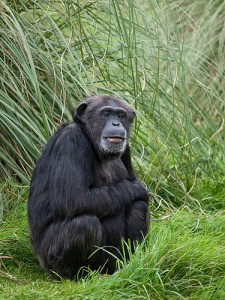
The US National Institutes of Health (NIH) announced today that it will retire to sanctuary nearly all of its research chimpanzees — about 310 animals — leaving a rump colony of up to 50 animals available to researchers who can clear high ethical and regulatory hurdles for using them. The announcement marks the end of a protracted process, kicked off by a landmark Institute of Medicine report, during which NIH-funded chimpanzee research has come under increasing scrutiny. Separately, the US Fish and Wildlife Service last week said it would declare captive chimps endangered, which also would make the animals tougher to access for biomedical research. The United States is the only major country that still funds invasive chimpanzee research. Francis Collins, the NIH director, called today’s decision a “real watershed”. “I am confident that greatly reducing their use in biomedical research is scientifically sound and the right thing to do,” he said. The decision is outlined in greater detail here. The NIH said that it would accept all of the recommendations made by an agency working group in January for disposition of the 310 chimpanzees that it now plans to retire, with one exception: in defining appropriate housing going forward, the working group had recommended 1,000 square feet (93 square metres) of space per animal. “We did not feel there was adequate scientific evidence” to support that requirement, Collins said. He added that the NIH would consult experts and do further review before determining the space allotment that it will require per animal. Under current rules, lab animals can be confined in as little as 25 square feet (2.3 square metres) of space. The NIH will not breed any of the 50 remaining research animals and will reassess the need for that rump colony in five years, Collins said. The physical placement of the retiring animals, and which ones to use in the residual research colony, remains to be worked out by the agency over the coming months and years. Chimp Haven in Louisiana, the only existing federal sanctuary, is near capacity, although it is undertaking a private fundraising campaign to allow expansion. The problem of supporting the retired animals in the future is compounded by a US$30-million cap on their support by the NIH that was written into law in the Chimp Act of 2000. That spending has now reached $29.2 million, says Kathy Hudson, NIH deputy director for science, outreach and policy. She says that the agency is working with Congress to amend the act to allow for future funding, and anticipates needing a new $3 million in 2014. Collins said that six of nine existing invasive experiments supported by the agency will be ended. He would not specify which ones, ahead of notifying the scientists involved. Directors of the NIH-supported chimpanzee research centres were not immediately available for comment. Animal-rights groups celebrated most aspects of the announcement. The Humane Society of the United States called it “monumental”. “Nearly all current NIH-funded invasive research will be phased out…and the barrier to new invasive research will be very high,” says John Pippin, director of medical affairs for the animal advocacy group Physicians Committee for Responsible Medicine in Washington DC. However, chimp research opponents decried the NIH’s decision not to immediately adopt the requirement of 1,000 square feet of space per animal. Stacy Lopresti-Goodman, a psychologist at Marymount University in Arlington, Virginia, works with chimpanzees at the Save the Chimps sanctuary in Florida. She says that groups of 12–25 chimpanzees live there, with an island of 3–5 acres for each group. She says that, even if the NIH abides by the new recommendation, the 50 chimpanzees in the NIH’s scaled-down research colony would be confined to just over 1 acre of space. “It is frankly outrageous that the NIH suggests the conditions for chimpanzees locked in laboratories are in any way comparable to what they are provided in sanctuaries,” she says. Lopresti-Goodman was responding to a comment by James Anderson, NIH deputy director for program coordination, planning and strategic initiatives, who described the environments in the research centres and sanctuaries as “not tremendously different”.

Russian Academy gets temporary reprieve

The Russian Academy of Sciences (RAS), threatened with liquidation, has been granted a temporary reprieve. The Duma — the Russian Parliament — agreed today to postpone until October its final vote on a bill that some feel will mark the end of the academy, founded in 1724 by Peter the Great. The Russian Academy of Science is to be axed The Russian Academy of Sciences is to be axed. QUIRIN SCHIERMEIER The Russian government, at a meeting last week, launched a bill proposing fundamental changes to the academy. According to the bill, dated 28 June, the academy is to merge with two minor societies — the Russian Academy of Medical Sciences and the Russian Academy of Agricultural Sciences. The responsibility for the more than 400 research institutes now under the academy’s auspices would be transferred to a new government-run agency. “It was a shocking surprise, says Vladimir Fortov, a physicist who in May was elected as the new president of the RAS. “I’ve learned of the existence of that bill only on the eve of the government meeting on Thursday.” The government had reportedly hoped to push the law through the Duma by the end of this week. Fortov says that he spent the last couple of days running from pillar to post trying to persuade Duma members to refrain from voting that early. Eventually, the academy leadership and the science ministry agreed to have further discussions before the Duma votes on the bill after the summer break. There have been long-running concerns over the dwindling scientific performance of many of the academy’s institutes. Critics say that the academy has been excessively reluctant to adopt the changes — including the introduction of a merit-based funding system based on peer review, and closure of severely under-performing institutes — that the Russian government has repeatedly urged it to make. Fortov has previously said that he will introduce regular performance reviews and a number of other measures to make the academy more efficient. He is to remain at the helm of the new united academy, but his reform ideas might be rendered obsolete, as the envisaged new body — stripped of its management role — would bear little resemblance to the former RAS. Russian scientists are split over the plans. Many admit that the RAS is in dire need of reform. But most are also deeply disturbed and outraged by the government’s attempt to make sweeping changes to country’s research landscape without consulting scientists. A small group of foreign scientists working in Russia has voiced concerns that the loss of the RAS, without adequate replacement, will be a “devastating blow to Russian science”.
NIH sees surge in open-access manuscripts
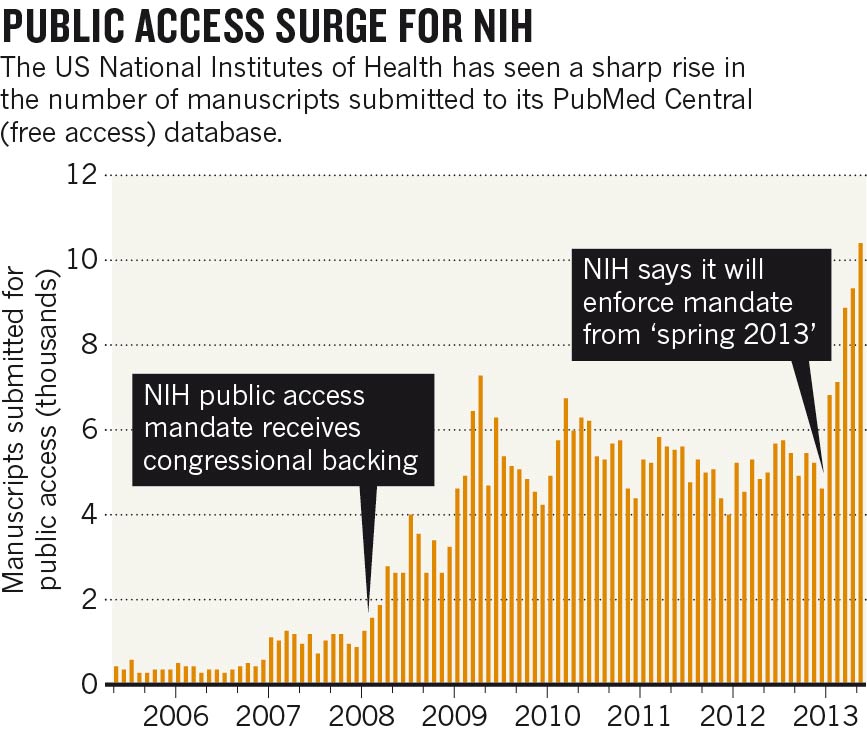
In May, authors approved more than 10,000 peer-reviewed manuscripts arising from NIH-funded research to go into the agency’s online free repository, PubMed Central. That’s a huge jump from the average 5,100 per month in 2011–12, and suggests the agency is nearing its goal of getting everyone it funds to make their papers publicly available. (Numbers available in csv format; the NIH also publishes them, so far without the


The Ring Style Wake Up Prank!
The Ring Style Wake Up Prank! - The Official Video - - Waking up to a Ghost coming out of TV screen


DJ Khaled Proposes To Young Money Member

With ring in hand, DJ Khaled proposed to Nicki Minaj via MTV. In a recnet video clip, Khaled can be seen proffessing his love for Nicki and asks for her hand in marriage. “Nicki Minaj, I’m at MTV, I want to be honest with you. I love you. I like you. I want you to be mine. I’m here at MTV because it’s a world wide network and the only reason I’m not telling you this face-to-face is because I understand that you’re busy. I’m gonna be honest with you, I want to marry you. … Nicki Minaj, will you marry me? We got the same symptons, we both suffer from success.” (MTV)


Europe launches massive laser communications satellite
 On Thursday Europe launched into orbit the most massive telecommunications satellite ever built on the continent. Managed by the European Space Agency and commercial operator Inmarsat, the 6.6-tonne Alphasat will relay data between different spots on the globe — using radio waves in the already crowded L-band frequency range. But it will also test out a laser communication device that could give a boost to space communications.
One piece of experimental equipment will broadcast at the higher and underused frequencies in the Q/V band. Higher frequencies encode more information, increasing the bandwidth available for transmissions. Sending such signals to the ground has been technically challenging because they are more easily disturbed by the atmosphere.
A second device will shoot and detect beams of laser light that have even higher frequencies and can carry even more information. Other satellites equipped with such terminals will be able to send information from low-Earth orbit up to Alphasat, which will relay the data to the ground from its high geosynchronous orbit. This will be the first step towards a network of laser-relay satellites intended to handle data from a planned fleet of European Earth-observing satellites.
An advanced star tracker particularly resistant to radiation will help these communications systems to aim their messages. Like a mariner out on the sea, it observes the stars to help the craft orient itself properly.
The Ariane 5 rocket that carried Alphasat also put into orbit INSAT-3D. This satellite will provide weather forecasting services to India.
On Thursday Europe launched into orbit the most massive telecommunications satellite ever built on the continent. Managed by the European Space Agency and commercial operator Inmarsat, the 6.6-tonne Alphasat will relay data between different spots on the globe — using radio waves in the already crowded L-band frequency range. But it will also test out a laser communication device that could give a boost to space communications.
One piece of experimental equipment will broadcast at the higher and underused frequencies in the Q/V band. Higher frequencies encode more information, increasing the bandwidth available for transmissions. Sending such signals to the ground has been technically challenging because they are more easily disturbed by the atmosphere.
A second device will shoot and detect beams of laser light that have even higher frequencies and can carry even more information. Other satellites equipped with such terminals will be able to send information from low-Earth orbit up to Alphasat, which will relay the data to the ground from its high geosynchronous orbit. This will be the first step towards a network of laser-relay satellites intended to handle data from a planned fleet of European Earth-observing satellites.
An advanced star tracker particularly resistant to radiation will help these communications systems to aim their messages. Like a mariner out on the sea, it observes the stars to help the craft orient itself properly.
The Ariane 5 rocket that carried Alphasat also put into orbit INSAT-3D. This satellite will provide weather forecasting services to India.
Obama nominates astrophysicist to lead NSF
 Astrophysicist France Anne Córdova has been tapped to head the US National Science Foundation (NSF), which has been run by an acting director since March 2013. President Barack Obama announced the pick on 31 July. If confirmed, Córdova would fill the gap left by Subra Suresh, who announced his resignation in February, after serving less than half of his six-year term leading the US$7 billion agency.
Córdova, who earned her doctorate from the California Institute of Technology in Pasadena, served as president of Purdue University in West Lafayette, Indiana, from 2007 to 2012. In 2010, she oversaw the creation of the Colombia-Purdue Institute for Scientific Research, which aims to foster scientific collaboration between the Colombia and the United States.
Earlier in her career, Córdova worked in the Earth and Space Sciences Division at Los Alamos National Laboratory in New Mexico, and went on to lead the department of astronomy and astrophysics at Pennsylvania State University in University Park. In September 1993, Córdova was named NASA’s first female chief scientist.
“She’s a very accomplished academic researcher,” says Umar Mohideen, chairman of the physics and astronomy department at the University of California, Riverside, where Córdova served as chancellor from 2002-2007. “She’s managed academia, and those are qualities that would make her a good choice.”
Córdova now begins the sometimes lengthy process of winning confirmation from the US Senate — normally an easy process for candidates to lead NSF. But her nomination comes at a time when Republican lawmakers in the Senate have used procedural tactics to slow consideration of Obama administration picks. EPA chief Gina McCarthy was confirmed on 18 July after a historic delay caused by political infighting, and Obama has struggled to fill several other top science positions.
Astrophysicist France Anne Córdova has been tapped to head the US National Science Foundation (NSF), which has been run by an acting director since March 2013. President Barack Obama announced the pick on 31 July. If confirmed, Córdova would fill the gap left by Subra Suresh, who announced his resignation in February, after serving less than half of his six-year term leading the US$7 billion agency.
Córdova, who earned her doctorate from the California Institute of Technology in Pasadena, served as president of Purdue University in West Lafayette, Indiana, from 2007 to 2012. In 2010, she oversaw the creation of the Colombia-Purdue Institute for Scientific Research, which aims to foster scientific collaboration between the Colombia and the United States.
Earlier in her career, Córdova worked in the Earth and Space Sciences Division at Los Alamos National Laboratory in New Mexico, and went on to lead the department of astronomy and astrophysics at Pennsylvania State University in University Park. In September 1993, Córdova was named NASA’s first female chief scientist.
“She’s a very accomplished academic researcher,” says Umar Mohideen, chairman of the physics and astronomy department at the University of California, Riverside, where Córdova served as chancellor from 2002-2007. “She’s managed academia, and those are qualities that would make her a good choice.”
Córdova now begins the sometimes lengthy process of winning confirmation from the US Senate — normally an easy process for candidates to lead NSF. But her nomination comes at a time when Republican lawmakers in the Senate have used procedural tactics to slow consideration of Obama administration picks. EPA chief Gina McCarthy was confirmed on 18 July after a historic delay caused by political infighting, and Obama has struggled to fill several other top science positions.
Why rabbits have white tails
 Why should an animal that wants to avoid being eaten have a bright white patch on its rump?
Rabbits are one of the many animals that have the apparently contradictory features of carefully camouflaged coats and hugely conspicuous rump patches that appear when the animals flee predators.
Dirk Semmann, an evolutionary biologist at the University of Göttingen in Germany, thinks he has the answer to this puzzle — and the evidence to back it up. Other theories hold that rump patches are warning to other animals, are sexually selected, or serve to show a predator that they have been spotted.
Semmann’s research suggests that these spots actually confuse predators because of their very noticeable nature. By focusing on the bright spot, the would-be predator ignores the larger body of the animal. Then, when the rabbit executes a sharp turn, the spot disappears and the predator has to readjust to focus on the camouflaged coat, losing vital seconds.
“The idea first appeared when I was running,” says Semmann. “I met this rabbit; it was always running and turning at some point. That got me thinking about the problem.”
To test his theory Semmann had 24 people play a video game in which they attempted to follow a ‘rabbit’ with or without a flashing tail — indicated by coloured circles that blended into the background or white circles that stood out — as it made a sharp turn.
Although the ‘hunters’ were good at making the correct decision within 0.5 seconds in both cases, the presence of a ‘tail’ significantly reduced their number of correct calls. Semmann’s conclusion, presented in Newcastle, UK, at the Behaviour 2013 conference, is that there is a direct benefit to rump patches: they make a rabbit more likely to survive a hunt.
Why should an animal that wants to avoid being eaten have a bright white patch on its rump?
Rabbits are one of the many animals that have the apparently contradictory features of carefully camouflaged coats and hugely conspicuous rump patches that appear when the animals flee predators.
Dirk Semmann, an evolutionary biologist at the University of Göttingen in Germany, thinks he has the answer to this puzzle — and the evidence to back it up. Other theories hold that rump patches are warning to other animals, are sexually selected, or serve to show a predator that they have been spotted.
Semmann’s research suggests that these spots actually confuse predators because of their very noticeable nature. By focusing on the bright spot, the would-be predator ignores the larger body of the animal. Then, when the rabbit executes a sharp turn, the spot disappears and the predator has to readjust to focus on the camouflaged coat, losing vital seconds.
“The idea first appeared when I was running,” says Semmann. “I met this rabbit; it was always running and turning at some point. That got me thinking about the problem.”
To test his theory Semmann had 24 people play a video game in which they attempted to follow a ‘rabbit’ with or without a flashing tail — indicated by coloured circles that blended into the background or white circles that stood out — as it made a sharp turn.
Although the ‘hunters’ were good at making the correct decision within 0.5 seconds in both cases, the presence of a ‘tail’ significantly reduced their number of correct calls. Semmann’s conclusion, presented in Newcastle, UK, at the Behaviour 2013 conference, is that there is a direct benefit to rump patches: they make a rabbit more likely to survive a hunt.
Experiments reveal that crabs and lobsters feel pain
 very year thousands of them are boiled or torn apart while they are still alive, and now there is strong evidence to suggest that crustaceans experience pain.
That was the stark message delivered by Robert Elwood, an animal behaviour researcher at Queen’s University Belfast, to the Behaviour 2013 meeting in Newcastle, UK, today.
Crustaceans — crabs, prawns, lobsters and other creatures — are generally not protected by animal-welfare laws, despite huge numbers of them being caught or farmed for human consumption. The exclusion has been based on the belief that these animals cannot experience pain — generally regarded as an ‘unpleasant feeling’ — and instead only have nociception, a reflex response to move away from a noxious stimulus.
This is a useful belief, as crustaceans are subjected to what Elwood calls “extreme procedures” — lobsters in factories having their legs removed while they are still alive, crabs being kept alive but tightly bound for days in fish markets, and live prawns being impaled on sticks for eating. Such procedures, he notes, “would never be allowed with vertebrates”.
One way Elwood attempted to determine whether crustaceans can experience pain was to look at avoidance learning: can the animals actually learn from pain, or do they just continue to respond to a stimulus? To answer this, Elwood and his colleague Barry Magee presented shore crabs with a choice of two different shelters. Entering one shelter resulted in an electric shock for the animal, which was repeated if the animal remained there. The other shelter was a safe haven.
Crabs shocked the second time the experiment was run were far more likely to choose the other shelter in the next trial, while crabs never left a non-shocking shelter. This, says Elwood, shows that the shock is aversive.
In another experiment Elwood investigated whether hermit crabs could make motivational trade-offs as a result of pain. They presented Pagurus bernhardus crabs with two types of shell, one of which the animals are known to prefer, and gave some of the animals small electric shocks when they were inside these new homes.
When these crabs were later presented with a new shell they could move into, the shocked crabs were more likely to take up this offer, and they did so more quickly.
“Assessing pain is difficult, even within humans,” Elwood told the Newcastle meeting. But there is a “clear, long-term motivational change [in these experiments] that is entirely consistent with the idea of pain”.
Such evidence would be enough to prevent mice being subjected to the deaths that crustaceans experience, he says.
Robert Hubrecht, deputy director of the Universities Federation for Animal Welfare (UFAW) and the organizer of the session at which Elwood gave his talk, says that the data for crustaceans appear equivalent to the kind of data that are used to give mice the benefit of the doubt, and thus award them protection from possible pain under the law.
“We’re behaving in an illogical way at the moment” by protecting mice but not crustaceans, he notes.
Whether wider society is ready to consider crabs as things that can feel pain and should be protected is not clear. “This is somewhere science has to lead,” says Hubrecht.
very year thousands of them are boiled or torn apart while they are still alive, and now there is strong evidence to suggest that crustaceans experience pain.
That was the stark message delivered by Robert Elwood, an animal behaviour researcher at Queen’s University Belfast, to the Behaviour 2013 meeting in Newcastle, UK, today.
Crustaceans — crabs, prawns, lobsters and other creatures — are generally not protected by animal-welfare laws, despite huge numbers of them being caught or farmed for human consumption. The exclusion has been based on the belief that these animals cannot experience pain — generally regarded as an ‘unpleasant feeling’ — and instead only have nociception, a reflex response to move away from a noxious stimulus.
This is a useful belief, as crustaceans are subjected to what Elwood calls “extreme procedures” — lobsters in factories having their legs removed while they are still alive, crabs being kept alive but tightly bound for days in fish markets, and live prawns being impaled on sticks for eating. Such procedures, he notes, “would never be allowed with vertebrates”.
One way Elwood attempted to determine whether crustaceans can experience pain was to look at avoidance learning: can the animals actually learn from pain, or do they just continue to respond to a stimulus? To answer this, Elwood and his colleague Barry Magee presented shore crabs with a choice of two different shelters. Entering one shelter resulted in an electric shock for the animal, which was repeated if the animal remained there. The other shelter was a safe haven.
Crabs shocked the second time the experiment was run were far more likely to choose the other shelter in the next trial, while crabs never left a non-shocking shelter. This, says Elwood, shows that the shock is aversive.
In another experiment Elwood investigated whether hermit crabs could make motivational trade-offs as a result of pain. They presented Pagurus bernhardus crabs with two types of shell, one of which the animals are known to prefer, and gave some of the animals small electric shocks when they were inside these new homes.
When these crabs were later presented with a new shell they could move into, the shocked crabs were more likely to take up this offer, and they did so more quickly.
“Assessing pain is difficult, even within humans,” Elwood told the Newcastle meeting. But there is a “clear, long-term motivational change [in these experiments] that is entirely consistent with the idea of pain”.
Such evidence would be enough to prevent mice being subjected to the deaths that crustaceans experience, he says.
Robert Hubrecht, deputy director of the Universities Federation for Animal Welfare (UFAW) and the organizer of the session at which Elwood gave his talk, says that the data for crustaceans appear equivalent to the kind of data that are used to give mice the benefit of the doubt, and thus award them protection from possible pain under the law.
“We’re behaving in an illogical way at the moment” by protecting mice but not crustaceans, he notes.
Whether wider society is ready to consider crabs as things that can feel pain and should be protected is not clear. “This is somewhere science has to lead,” says Hubrecht.
Pitch-drop custodian dies without witnessing a drop fall

John Mainstone, who for 52 years tended to one of the world’s longest-running laboratory experiments but never saw it bear fruit with his own eyes, died on 23 August after suffering a stroke. He was 78. Mainstone had been looking after the pitch drop experiment at the University of Queensland in Brisbane, Australia since he arrived at the university as a physics professor in 1961. The experiment, set up in 1927 by the university’s first head of the physics department, Thomas Parnell, consists of a sample of tar pitch slowly running through a funnel (see ‘Long-term research: Slow science‘). The pitch forms a drop that falls into a waiting beaker about once every decade or so. In the 52 years that Mainstone spent watching the pitch, he never managed to see a drop fall. In 2000, when the 8th drop fell, the webcam set up to capture it failed at the critical moment. With three cameras trained on it now, Mainstone was looking forward to finally seeing the experiment in action later this year, when the 9th drop is expected to fall. But sadly the pitch proved too slow-moving for him in the end. Mainstone did, however, get to see video of a drop falling from a similar experiment in Ireland earlier this summer. “I have been examining the video over and over again,” he told Nature at the time, ”and there were a number of things about it that were really quite tantalizing for a very long time pitch-drop observer like myself.” The pitch drop had become famous in the past few decades, thanks in no small part to Mainstone’s years-long campaign to get the university to put it on public display. It is listed as the worlds longest-running laboratory experiment in the Guinness Book of World Records, and in 2005 Mainstone shared an IgNobel Prize in physics with Parnell for their work on it. Mainstone was always happy to talk about the experiment, and would explain enthusiastically (and at some length) what it meant not just for science, but for the wider culture, to have something that enables us to think more deeply about the passage of time, and our place in the universe. “It’s going about its business while the world is going though all sorts of turmoil,” he told Nature in January. This is not the end for the pitch drop experiment though. Mainstone had lined up his successor years ago, in anticipation of the time when he would no longer be able to take care of the apparatus, which has enough pitch in it to keep going for another 150 years. And so Andrew White, a physicist at the university and one of Mainstone’s former students, will now take over the vigil.
Taiwan court set to decide on libel case against scientist

A Taiwanese court will rule on 4 September in a libel lawsuit filed by a petrochemical company against an environmental engineer whose studies had suggested that a plant operated by the company was causing higher cancer rates in its vicinity. In December 2010 Ben-Jei Tsuang, an environmental engineer at Taiwan’s National Chung Hsing University in Taichung, presented evidence of increased cancer rates in residents living near a Formosa Plastics Group (FPG) hydrocarbon-processing facility in Mailao, Taiwan, at a scientific meeting. He also presented evidence in a press conference in November 2011. In April 2012, FPG sued Tsuang for defamation, demanding that he pay US$1.3 million in damages and that he publicly apologize by publishing a statement in four major newspapers. In the trial, which had its final hearing today at the Taipei District Court, Tsuang’s lawyers framed the case as a “strategic lawsuit against public participation”. An open letter signed by 1,000 academics, including chemistry Nobel laureate Lee Yuan Tseh, expressed support for Tsuang. “In the six previous hearings, FPG did not produce the emission inventory requested by the court. The judge remarked that this failure could affect the outcome of the case, so I am hopeful,” says Tsuang. “However, the company has been successful in preventing scientists from speaking up,” he says. For example, he says that Taiwan’s Environmental Agency did not investigate press reports showing alleged evidence of widespread cancer in a village close to an FPG factory. Whichever side the court’s ruling goes, it might not put an end to Tsuang’s case. Both he and FPG have the option to appeal it. Several high-profile libel cases involving scientists and science journalists in the United Kingdom over the past few years have led to a campaign that resulted in a reform of UK libel laws (Nature supported the campaign). A bill to update the law was approved in April.
Two scientists to join Italian senate
 Two scientists are among the four new senators for life appointed today by Italy’s president, Giorgio Napolitano. Particle physicist and Nobel Prize winner Carlo Rubbia and stem-cell specialist Elena Cattaneo will become permanent members of the Italian Senate, along with the orchestra conductor Claudio Abbado and the architect Renzo Piano, whose appointments were also announced today.
Born in 1934, Rubbia is one of Italy’s most famous and respected living scientists. He spent most of his career at the European Organization for Nuclear Research (CERN) in Geneva, where he also served as director general between 1989 and 1993. In 1984 he was awarded the Nobel Prize for physics together with Simon Van deer Meer for the discovery of the W and Z bosons, the particles responsible for the weak interaction, one of the four fundamental forces in nature.
The appointment of Elena Cattaneo is possibly more surprising. Cattaneo, who heads the Laboratory for Stem Cell Biology and Pharmacology of Neurodegenerative Diseases at the University of Milan, is a leading expert in her field, and only a few weeks ago became a member of the Accademia dei Lincei in Rome, Italy’s national academy. But outside the scientific community she is nowhere near as famous as Rubbia (let alone Piano or Abbado), and at 51 she is much younger than the average senator-for-life. In his official statement, Napolitano said that he wanted to appoint “a female scientist who is still young but has already achieved a lot” and that “choosing her is meant as an appreciation and an encouragement for many Italians of the new generations who commit themselves, amid difficulties, to scientific research”.
In the last few months Cattaneo has often taken strong public positions against the “Stamina” method, a controversial stem-cell therapy which most scientists consider unproved, but for which parliament has agreed to fund a trial (see ‘Italian stem-cell trial based on flawed data‘ and ‘Stem-cell ruling riles researchers‘). Napolitano made no reference to the controversy, but Cattaneo’s role in it may have helped her cause.
The appointments are a welcome surprise for Italian scientists, who are having had a hard time trying to make their voice heard in the capital and for instance have complained about restrictive regulation on animal research that were passed recently into law. Cattaneo and Rubbia will now have the same voting rights as elected senators — but for the rest of their lives. Their votes could be significant in a country where governments often survive on thin majorities: the late neuroscientist Rita Levi-Montalcini in 2006 threatened to vote against Romano Prodi’s government – kept alive by a handful of votes — unless he withdrew a plan to cut the budget for scientific research. It worked.
Italy’s constitution gives the president the power to appoint up to five senators for life during his mandate, for “high merits in the social, scientific, artistic and literary fields”. Since 1948 – when Italy become a Republic – presidents have appointed mostly former politicians and civil servants, with the addition of the occasional artist, writer or entrepreneur. Only two scientists had previously received the honour: mathematician Guido Castelnuovo in 1949 and Levi-Montalcini in 2001. The recent deaths of Montalcini, who passed away at the age of 103, and of three other senators for life had left four empty seats, which Napolitano has now filled.
Two scientists are among the four new senators for life appointed today by Italy’s president, Giorgio Napolitano. Particle physicist and Nobel Prize winner Carlo Rubbia and stem-cell specialist Elena Cattaneo will become permanent members of the Italian Senate, along with the orchestra conductor Claudio Abbado and the architect Renzo Piano, whose appointments were also announced today.
Born in 1934, Rubbia is one of Italy’s most famous and respected living scientists. He spent most of his career at the European Organization for Nuclear Research (CERN) in Geneva, where he also served as director general between 1989 and 1993. In 1984 he was awarded the Nobel Prize for physics together with Simon Van deer Meer for the discovery of the W and Z bosons, the particles responsible for the weak interaction, one of the four fundamental forces in nature.
The appointment of Elena Cattaneo is possibly more surprising. Cattaneo, who heads the Laboratory for Stem Cell Biology and Pharmacology of Neurodegenerative Diseases at the University of Milan, is a leading expert in her field, and only a few weeks ago became a member of the Accademia dei Lincei in Rome, Italy’s national academy. But outside the scientific community she is nowhere near as famous as Rubbia (let alone Piano or Abbado), and at 51 she is much younger than the average senator-for-life. In his official statement, Napolitano said that he wanted to appoint “a female scientist who is still young but has already achieved a lot” and that “choosing her is meant as an appreciation and an encouragement for many Italians of the new generations who commit themselves, amid difficulties, to scientific research”.
In the last few months Cattaneo has often taken strong public positions against the “Stamina” method, a controversial stem-cell therapy which most scientists consider unproved, but for which parliament has agreed to fund a trial (see ‘Italian stem-cell trial based on flawed data‘ and ‘Stem-cell ruling riles researchers‘). Napolitano made no reference to the controversy, but Cattaneo’s role in it may have helped her cause.
The appointments are a welcome surprise for Italian scientists, who are having had a hard time trying to make their voice heard in the capital and for instance have complained about restrictive regulation on animal research that were passed recently into law. Cattaneo and Rubbia will now have the same voting rights as elected senators — but for the rest of their lives. Their votes could be significant in a country where governments often survive on thin majorities: the late neuroscientist Rita Levi-Montalcini in 2006 threatened to vote against Romano Prodi’s government – kept alive by a handful of votes — unless he withdrew a plan to cut the budget for scientific research. It worked.
Italy’s constitution gives the president the power to appoint up to five senators for life during his mandate, for “high merits in the social, scientific, artistic and literary fields”. Since 1948 – when Italy become a Republic – presidents have appointed mostly former politicians and civil servants, with the addition of the occasional artist, writer or entrepreneur. Only two scientists had previously received the honour: mathematician Guido Castelnuovo in 1949 and Levi-Montalcini in 2001. The recent deaths of Montalcini, who passed away at the age of 103, and of three other senators for life had left four empty seats, which Napolitano has now filled.
Standard vaccines can offer protection against H5N1 pandemic flu
 Scientists may be able to protect humans from avian influenza viruses – before they have even evolved to spread among people.
An experimental flu vaccine designed for a bird-specific H5N1 influenza virus can protect humans from a lab-made H5N1 strain engineered to pass among mammals. The finding is published today in the Journal of Clinical Investigation.
The vaccine was made the same way as seasonal flu shots. But it was tested on a synthetic H5N1 flu, tweaked to
Controversial avian influenza work yields insight into combating looming viruses. EL ALVI/FLICKR
Controversial avian influenza work yields insight into combating looming viruses.
EL ALVI/FLICKR
spread among ferrets, a model of human infection. Doing any research of this sort has been dogged by heated debate and self-imposed moratoriums.
“The transmissible viruses are very scary because H5N1 has a very high mortality rate,” says lead author James Crowe, of Vanderbilt University in Nashville, Tennessee. But he says that the study justifies creating such dangerous pathogens in lab. “Our paper shows that there is a very clear mechanism for conventional vaccines to kill these things.”
Crowe and his colleagues took the blood of four patients given the experimental vaccine, and singled out the antibodies that could attack H5N1 viruses. They next wanted to test whether these antibodies could protect against the synthetic H5N1 virus — scientist’s best estimation of what a potentially pandemic virus may look like.
But scientists had enacted a voluntary moratorium on working with the highly pathogenic strains out of fear that they could get out of the lab or be used as a weapon.
To get around this, the researchers used DNA sequences from the synthetic virus to create pseudo-versions that would not cause disease. They found that antibodies from the patients’ blood could defeat the faux transmissible flu by binding between mutations that allow it to spread among mammals.
Richard Webby, a flu expert at St. Jude Children’s Research Hospital in Memphis, Tennessee, says that the finding confirms that vaccines based on the bird virus can still be useful against strains that become more infectious. “Those transmission changes didn’t really seem to affect the protection afforded by the vaccines,” he explains. Webby says that the approach could guide vaccine development for other looming avian flu viruses, such as H7N9.
But Simon Wain-Hobson, chair of the Foundation for Vaccine Research in Washington DC, is less convinced that the synthetic virus will exactly predict what a real pandemic H5N1 may do. Moreover, he says that the artificial virus did not lead to a better vaccine, which some scientists have claimed is the point of doing research with human-transmissible viruses.
Scientists may be able to protect humans from avian influenza viruses – before they have even evolved to spread among people.
An experimental flu vaccine designed for a bird-specific H5N1 influenza virus can protect humans from a lab-made H5N1 strain engineered to pass among mammals. The finding is published today in the Journal of Clinical Investigation.
The vaccine was made the same way as seasonal flu shots. But it was tested on a synthetic H5N1 flu, tweaked to
Controversial avian influenza work yields insight into combating looming viruses. EL ALVI/FLICKR
Controversial avian influenza work yields insight into combating looming viruses.
EL ALVI/FLICKR
spread among ferrets, a model of human infection. Doing any research of this sort has been dogged by heated debate and self-imposed moratoriums.
“The transmissible viruses are very scary because H5N1 has a very high mortality rate,” says lead author James Crowe, of Vanderbilt University in Nashville, Tennessee. But he says that the study justifies creating such dangerous pathogens in lab. “Our paper shows that there is a very clear mechanism for conventional vaccines to kill these things.”
Crowe and his colleagues took the blood of four patients given the experimental vaccine, and singled out the antibodies that could attack H5N1 viruses. They next wanted to test whether these antibodies could protect against the synthetic H5N1 virus — scientist’s best estimation of what a potentially pandemic virus may look like.
But scientists had enacted a voluntary moratorium on working with the highly pathogenic strains out of fear that they could get out of the lab or be used as a weapon.
To get around this, the researchers used DNA sequences from the synthetic virus to create pseudo-versions that would not cause disease. They found that antibodies from the patients’ blood could defeat the faux transmissible flu by binding between mutations that allow it to spread among mammals.
Richard Webby, a flu expert at St. Jude Children’s Research Hospital in Memphis, Tennessee, says that the finding confirms that vaccines based on the bird virus can still be useful against strains that become more infectious. “Those transmission changes didn’t really seem to affect the protection afforded by the vaccines,” he explains. Webby says that the approach could guide vaccine development for other looming avian flu viruses, such as H7N9.
But Simon Wain-Hobson, chair of the Foundation for Vaccine Research in Washington DC, is less convinced that the synthetic virus will exactly predict what a real pandemic H5N1 may do. Moreover, he says that the artificial virus did not lead to a better vaccine, which some scientists have claimed is the point of doing research with human-transmissible viruses.
Dark energy survey launches
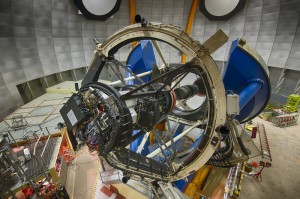 High in the Chilean Andes, a massive project to probe the nature of dark energy has begun.
The Dark Energy Survey (DES) launched on 31 August at the 4-metre Blanco telescope at the Cerro Tololo Inter-American Observatory. It is one of several new pushes to explore the physical properties of dark energy, the mysterious force that is driving the universe to expand at an ever-faster rate.
Over the course of five years, the DES will map 300 million galaxies over one-eighth of the night sky. Its backbone is a 570-megapixel digital camera (pictured, right), designed to capture sharp images of galaxies and galaxy clusters. Such high resolution is essential because the DES measures weak gravitational lensing, the phenomenon in which light from distant cosmic objects is subtly distorted by the gravity of matter between them and Earth.
Weak lensing can be hard to spot. A competing Japanese-led survey, which uses the Hyper Suprime-Cam in Hawaii, relies on an even more detailed, 870-megapixel camera. That camera is mounted on a larger machine, the 8.2-metre Subaru telescope, and so it can image fainter galaxies than the DES can. The DES covers more area on the sky, however. Both surveys aim to measure enough weak lensing to map matter across the universe — a three-dimensional web that can reveal the fingerprints of dark energy through time.
Along with weak lensing, the DES has a couple of other tools in its arsenal. To beef up the matter map, it will count galaxy clusters at different distances from Earth. And it will probe for distant supernovae, whose otherwise reference light is dimmed as the universe expands. This technique was originally used to discover the accelerating cosmic expansion, and netted its scientists the 2011 Nobel Prize in physics.
The DES also hopes to muscle in on the territory of studying sound waves in the early universe. Its sky maps could reveal the effects of pressure waves frozen in place some 370,000 years after the big bang. Those results, in turn, could shed light on how the expansion rate of the universe changed over time, presumably driven by dark energy.
But other approaches have a head start in this arena. The ongoing BOSS survey and its planned successor, BigBOSS, focus on taking spectra of these acoustic waves, known as baryon acoustic oscillations. BOSS has already mapped these cosmic ripples and provided some of the tightest constraints on dark energy through time.
High in the Chilean Andes, a massive project to probe the nature of dark energy has begun.
The Dark Energy Survey (DES) launched on 31 August at the 4-metre Blanco telescope at the Cerro Tololo Inter-American Observatory. It is one of several new pushes to explore the physical properties of dark energy, the mysterious force that is driving the universe to expand at an ever-faster rate.
Over the course of five years, the DES will map 300 million galaxies over one-eighth of the night sky. Its backbone is a 570-megapixel digital camera (pictured, right), designed to capture sharp images of galaxies and galaxy clusters. Such high resolution is essential because the DES measures weak gravitational lensing, the phenomenon in which light from distant cosmic objects is subtly distorted by the gravity of matter between them and Earth.
Weak lensing can be hard to spot. A competing Japanese-led survey, which uses the Hyper Suprime-Cam in Hawaii, relies on an even more detailed, 870-megapixel camera. That camera is mounted on a larger machine, the 8.2-metre Subaru telescope, and so it can image fainter galaxies than the DES can. The DES covers more area on the sky, however. Both surveys aim to measure enough weak lensing to map matter across the universe — a three-dimensional web that can reveal the fingerprints of dark energy through time.
Along with weak lensing, the DES has a couple of other tools in its arsenal. To beef up the matter map, it will count galaxy clusters at different distances from Earth. And it will probe for distant supernovae, whose otherwise reference light is dimmed as the universe expands. This technique was originally used to discover the accelerating cosmic expansion, and netted its scientists the 2011 Nobel Prize in physics.
The DES also hopes to muscle in on the territory of studying sound waves in the early universe. Its sky maps could reveal the effects of pressure waves frozen in place some 370,000 years after the big bang. Those results, in turn, could shed light on how the expansion rate of the universe changed over time, presumably driven by dark energy.
But other approaches have a head start in this arena. The ongoing BOSS survey and its planned successor, BigBOSS, focus on taking spectra of these acoustic waves, known as baryon acoustic oscillations. BOSS has already mapped these cosmic ripples and provided some of the tightest constraints on dark energy through time.
Subscribe to:
Comments (Atom)